
Why Waiting for Interest Rates to Drop Could Cost You a Fortune in West Michigan
By Chris Simpson, REALTOR® | Five Star Real Estate • West Michigan Lakeshore Market
Estimated read time: 11 minutes
If you’ve been telling yourself “I’ll wait until rates come down,” you have plenty of company. Across Muskegon, Norton Shores, Grand Haven, North Muskegon, and Fruitport, I’m hearing the same thing from buyers right now: mortgage rates feel too high, so it makes more sense to sit tight and watch the market from the sidelines.
It's a reasonable instinct. It's also, in most cases, the more expensive choice. Mortgage rates are only one half of what determines your monthly payment — the other half is the price of the home itself, and those two numbers move against each other more often than buyers expect. When rates fall, buyers who were waiting come off the sidelines all at once, competition returns, and prices climb to absorb the savings. History backs this up again and again.
This post walks through 56 years of mortgage rate data, explains the competition-and-price relationship in plain terms, and lays out a realistic, judgment-free way to think about buying now versus waiting — including why refinancing later is usually a far better plan than waiting to buy later.
56 Years of Mortgage Rate History, at a Glance
Context matters. Today's 30-year fixed rate sits in the low-to-mid 6% range — higher than the ultra-cheap money of 2012–2021, but well below the 56-year historical average of about 7.7%, and nowhere close to the double-digit rates that were completely normal from the late 1970s through the early 1990s.
30-year fixed mortgage rate, annual averages, 1971–2026. Source: Freddie Mac Primary Mortgage Market Survey (PMMS). 2026 figure is year-to-date.
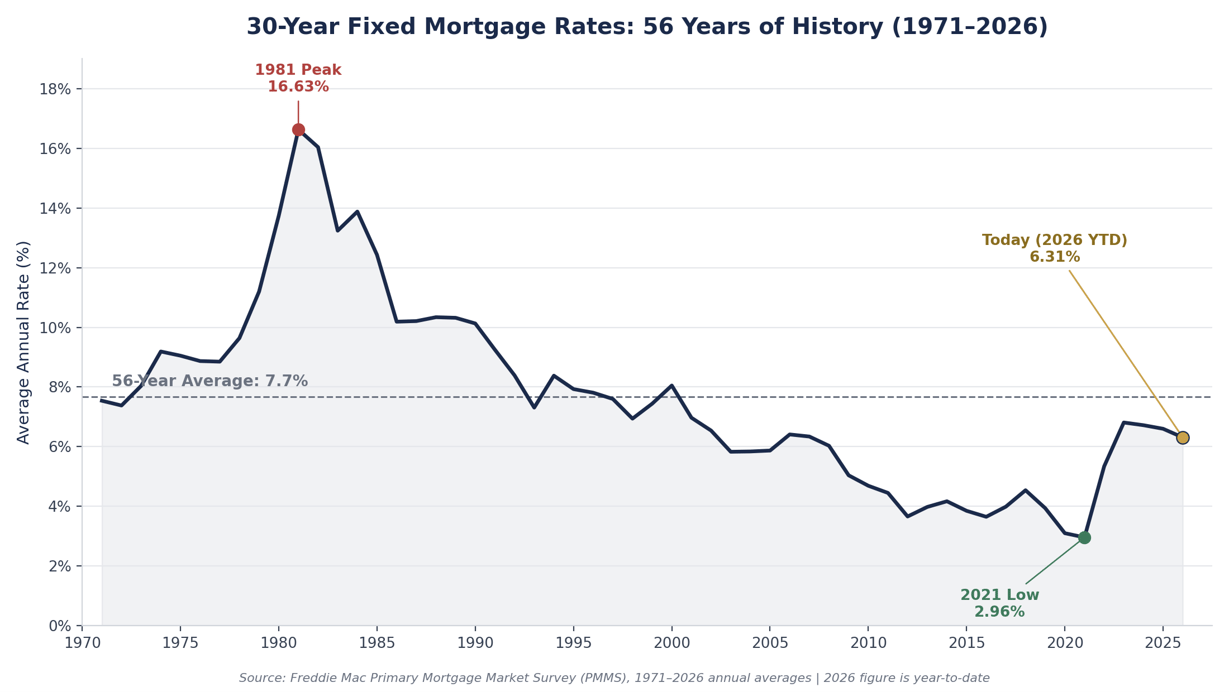
A few takeaways from the chart:
• The all-time peak was 16.63% in 1981, during the Federal Reserve's fight against runaway inflation.
• The all-time low was 2.96% in 2021, a once-in-a-generation event driven by emergency pandemic-era policy — not a “normal” rate anyone should plan around returning to.
• The 56-year average is roughly 7.7%. Buyers who bought in the 5–6% range for most of the 2000s and 2010s were actually buying below the long-run historical norm.
• Rates have moved in both directions many times, sometimes swinging several points within a single year — which is exactly why “I'll just wait for it to get better” is a much harder bet to time than it sounds.
Why Lower Rates Bring More Competition — and Higher Prices
Here's the mechanism buyers waiting on the sidelines often miss: a lower interest rate doesn't just make your future payment smaller. It also makes every other buyer's future payment smaller, which means more people can afford to compete for the same limited number of homes.
In West Michigan, and nationally, that pattern has played out clearly. When the 30-year rate fell to record lows near 2.96% in 2021, homebuyers who had been waiting flooded back into the market. According to the S&P CoreLogic Case-Shiller U.S. National Home Price Index, national home prices were posting year-over-year gains as high as 19–20% by early-to-mid 2022, with many metro areas seeing even larger jumps. Buyers who “waited for a better rate” and got one often ended up paying tens of thousands of dollars more for the same home simply because everyone else was doing the math at the same time.
The reverse is also true. When rates rise, buyer demand thins out, competition eases, sellers get more realistic about pricing, and there's more room to negotiate — concessions, repairs, closing cost credits, and price flexibility that simply don't exist in a multiple-offer market. That's closer to the environment we're in today across the Muskegon lakeshore: rates are elevated, some buyers have paused, and that's opened up real negotiating room for the buyers who are still active.
Put simply: a high-rate, low-competition market and a low-rate, high-competition market can land you in a very similar monthly payment — the difference is what you paid for the home and how much leverage you had at the closing table.
The Math Buyers Skip: A West Michigan Example
Let's make this concrete with a simplified, illustrative example (actual figures will vary by your credit, down payment, loan program, and the specific home):
Say a West Michigan lakeshore-area home is listed today at $290,000, and a buyer finances 90% of the purchase at a 6.3% 30-year fixed rate. That's roughly $1,616 a month in principal and interest.
Now imagine that buyer waits a year. Rates ease to 5.5% — a genuinely large improvement — but because lower rates pull more buyers back into the market, that same home (or a comparable one) has appreciated a modest 6% to about $307,400. Financing 90% of that price at 5.5% comes out to roughly $1,571 a month.
Result: after waiting a full year for a meaningfully better rate, the monthly payment drops by only about $45 — while the buyer paid a higher price, built a year less equity, and spent a year paying rent instead.
That's the trap. The rate improvement gets partially or fully absorbed by the price increase, because the same rate drop that helped this buyer also brought back every other buyer who'd been waiting. Meanwhile, home prices in Michigan have continued trending upward — the statewide median sits around $295,000, up nearly 5% year-over-year, and several West Michigan lakeshore communities have seen comparable or steeper gains.
This isn't a guarantee that prices will always rise, and it isn't a reason to buy a home that doesn't fit your budget. It's a reason to run the real numbers — payment, price, and timeline together — rather than fixating on the interest rate in isolation.
“Marry the House, Date the Rate”: Why Refinancing Later Beats Waiting to Buy Later
There's a well-known saying among real estate and mortgage professionals: marry the house, date the rate. The idea is simple — your purchase price and your home's location are largely locked in the day you buy. Your interest rate is not.
If you buy now at today's rate and rates genuinely fall in a year or two, you have a straightforward path available: refinance. A refinance replaces your existing loan with a new one at a lower rate, typically for the cost of new closing costs (often 2–6% of the loan amount, sometimes rolled into the loan or offset with a no-closing-cost refinance option). You keep the home you already own, keep the equity you've already built, and simply lower your payment going forward.
Compare that to waiting to buy: there's no way to “refinance” your way into a lower purchase price after the fact. If prices rise while you wait, that cost is permanent — it's baked into the loan for the life of the mortgage unless you refinance a larger balance down the road.
A few practical notes if this is your plan:
• Ask your lender about loan programs with no prepayment penalty, so refinancing later is never restricted.
• Some lenders offer a one-time “refinance rate reduction” or float-down option with reduced fees — worth asking about when you lock your initial rate.
• Refinancing generally makes sense once the new rate is roughly 0.75–1 percentage point below your current rate, though the real break-even math depends on your closing costs and how long you plan to stay in the home.
• In the meantime, every payment you make is building equity in a home you own — not rent that builds equity for someone else.
What This Means for Muskegon, Norton Shores, Grand Haven, North Muskegon, and Fruitport
Home prices vary quite a bit even within a short drive along the lakeshore. The city of Muskegon remains one of the more affordable entry points in West Michigan, with typical home values well below many neighboring communities, while lakefront and near-lake pockets in Norton Shores, Grand Haven, and North Muskegon command a meaningful premium. Fruitport continues to draw buyers looking for a quieter, more suburban feel with easier access to Muskegon Lake and the Grand River.
Across the county, inventory has been easing compared with the ultra-tight conditions of a few years ago, and homes are sitting on the market a bit longer than they did during the height of the pandemic-era rate lows. That's meaningful: it means today's buyers, in most of these communities, are negotiating from a stronger position than buyers will likely have once rates drop and demand rebounds.
If your plan is to eventually own along the West Michigan lakeshore — whether that's a starter home in Muskegon, a family home in Norton Shores or Fruitport, or a lake-access property near Grand Haven or North Muskegon — the honest question isn't “will rates be lower next year?” It's “will this specific home, in this specific market, cost me less in total once I account for price growth, lost equity, and a year of rent?” For most buyers I work with right now, the answer points toward buying when the numbers work for your budget today, and treating a future rate drop as a bonus refinance opportunity rather than a reason to wait.
Frequently Asked Questions
Will home prices go up when mortgage rates drop?
Historically, yes, in most markets. Lower rates increase how much home buyers can afford, which pulls more buyers into the market at once. That added competition tends to push prices higher, which can offset some or all of the savings from the lower rate — as seen nationally in 2021–2022, when rates hit record lows and home prices simultaneously posted their fastest annual growth in decades.
Is it better to buy now at a higher rate or wait for rates to drop?
For most buyers who are financially ready and have found a home that fits their budget, buying now and refinancing later if rates fall is generally the stronger strategy. Waiting risks a higher purchase price, a year or more of rent instead of equity, and no guarantee that rates will actually fall on your timeline. Buying locks in today's price; refinancing keeps your rate flexible.
What is the average 30-year mortgage rate historically?
Based on Freddie Mac's Primary Mortgage Market Survey data going back to 1971, the 30-year fixed mortgage rate has averaged approximately 7.7% over the past 56 years. Rates below 6% — common through much of the 2010s — are actually below that long-term historical norm, not the standard buyers should expect as “normal.”
How much does refinancing cost, and when does it make sense?
Refinancing typically costs 2–6% of the loan amount in closing costs, which can often be rolled into the new loan or offset through a no-closing-cost refinance. It generally starts to make financial sense when the new rate is at least 0.75 to 1 percentage point below your current rate, though the true break-even point depends on your specific closing costs, loan balance, and how long you plan to stay in the home.
Are West Michigan home prices expected to keep rising?
Michigan's statewide median home price has been trending upward, and several West Michigan lakeshore communities have seen comparable or steeper appreciation, particularly in lake-access and near-lake neighborhoods. While no one can guarantee future price movement, current trends combined with historically normal (not historically low) mortgage rates suggest that waiting carries real cost risk for buyers who are otherwise ready to purchase.
The Bottom Line
Waiting for a lower interest rate is a bet — not a guarantee — and it's a bet against a market that has a strong historical habit of raising prices right when rates fall. If you're financially ready and you've found a home that fits your budget at today's rate, buying now and refinancing later if the opportunity comes gives you control over both sides of the equation: the price you pay and the rate you pay. Waiting gives you control over neither.
Thinking About Buying in West Michigan?
Let's run the real numbers together — today's rate, today's price, and what waiting could actually cost you. Reach out anytime for a no-pressure conversation about your options in Muskegon, Norton Shores, Grand Haven, North Muskegon, or Fruitport.
Chris Simpson | REALTOR®, Five Star Real Estate 📱 231-215-7229 ✉️ [email protected] 🌐 ChrisSimpsonWestMichiganRealEstate.com 📷 @MuskegonRealEstateAgent
About the Author
Chris Simpson is a licensed REALTOR® with Five Star Real Estate, serving buyers and sellers throughout the West Michigan lakeshore — including Muskegon, Norton Shores, Grand Haven, North Muskegon, and Fruitport. Chris writes weekly to help local buyers and sellers make sense of the market, from financing and rates to community events and home maintenance.
#MuskegonRealEstate #WestMichiganRealtor #NortonShoresMI #GrandHavenMI #NorthMuskegon #FruitportMI #MortgageRates #ShouldIBuyNow #WestMichiganLakeshore #FiveStarRealEstate


